

Introduction to Acute Kidney Injury
Acute Kidney Injury is a serious clinical condition characterized by a sudden reduction in kidney function occurring over a period of hours to days. Historically referred to as acute renal failure, the terminology evolved to “acute kidney injury” in order to better reflect the progressive and continuous nature of renal damage. This modern concept emphasizes that kidney dysfunction develops gradually across a spectrum of severity rather than appearing only when complete renal failure becomes evident.
The kidneys play a critical role in maintaining internal physiological balance through the filtration of blood, elimination of metabolic waste products, regulation of electrolytes, acid-base balance, blood pressure control, and fluid homeostasis. When acute kidney injury develops, these essential renal functions become impaired, leading to the accumulation of nitrogenous waste products such as creatinine and urea within the bloodstream. In parallel, disturbances in electrolyte and metabolic regulation emerge, including hyperkalemia, hyperphosphatemia, metabolic acidosis, and abnormalities in fluid balance.
One of the most important clinical manifestations of AKI is reduced urine output, known as oliguria, although some patients may maintain apparently normal urine production despite significant renal injury. The disorder can progress rapidly and is associated with substantial morbidity and mortality, especially among critically ill patients admitted to intensive care units.
Modern clinical understanding recognizes AKI as a continuum ranging from mild functional impairment to severe structural kidney damage requiring renal replacement therapy such as dialysis. Even small elevations in serum creatinine are now known to correlate with increased mortality risk, prolonged hospitalization, and future chronic kidney disease development.
Epidemiology of Acute Kidney Injury

Pathophysiology of Acute Kidney Injury
The pathophysiology of AKI is highly complex and involves intertwined hemodynamic, inflammatory, immunological, vascular, and cellular mechanisms. Modern research increasingly demonstrates that AKI is not merely a disorder of reduced blood flow but a multifactorial syndrome involving extensive molecular and cellular injury pathways.
Renal Hypoperfusion and Ischemia
One of the primary initiating events in many forms of AKI is reduced renal perfusion. Decreased blood flow to the kidneys may result from:
- Severe dehydration
- Hemorrhage
- Septic shock
- Heart failure
- Major surgery
- Liver failure
- Burns or trauma
When renal perfusion declines significantly, oxygen delivery to kidney tissues becomes inadequate. Renal tubular epithelial cells, especially within the proximal tubules and medullary thick ascending limb, are highly metabolically active and therefore extremely vulnerable to ischemic injury.
Persistent hypoperfusion leads to:
- Tubular epithelial cell damage
- Mitochondrial dysfunction
- ATP depletion
- Oxidative stress
- Cellular apoptosis and necrosis
- Loss of epithelial polarity
- Tubular obstruction

Inflammatory and Immune Mechanisms
Acute kidney injury is increasingly recognized as a systemic inflammatory disorder rather than solely a hemodynamic abnormality.
Inflammatory activation during AKI includes:
- Cytokine release
- Leukocyte infiltration
- Endothelial dysfunction
- Activation of toll-like receptors
- Complement system activation
- Oxidative injury
- Microvascular dysfunction
Sepsis-associated AKI particularly illustrates the importance of inflammation. In many septic patients, renal blood flow may remain relatively preserved, yet severe renal dysfunction still develops due to microcirculatory abnormalities and inflammatory cellular injury.

Neurohormonal Activation in AKI
Several neurohormonal systems become activated during renal hypoperfusion and systemic circulatory stress.
Renin–Angiotensin–Aldosterone System
Renin→Angiotensin II→Aldosteron
Activation of the renin–angiotensin–aldosterone system promotes renal vasoconstriction, sodium retention, and reduced glomerular filtration.
Sympathetic nervous system stimulation further contributes to renal vasoconstriction and decreased renal perfusion.
Arginine vasopressin secretion increases water retention and may aggravate fluid overload.
These compensatory responses initially aim to preserve systemic circulation but may paradoxically worsen kidney injury if prolonged.

Acute Tubular Necrosis and the Evolution of AKI Concepts
The classical concept of acute tubular necrosis (ATN) has been increasingly questioned in modern nephrology.
Traditionally, ATN referred to structural tubular damage resulting from prolonged ischemia or nephrotoxic exposure. However, several limitations exist:
- Histological confirmation is rarely obtained
- Many patients show functional renal impairment without clear necrosis
- AKI exists along a continuum rather than discrete categories
- Structural and functional injury frequently overlap
Current perspectives therefore favor broader terminology emphasizing the continuum of kidney injury rather than rigid separation between prerenal azotemia and intrinsic renal failure.

Clinical Manifestations of Acute Kidney Injury
AKI often develops silently during another acute illness. Symptoms may initially be nonspecific and can include:
- Fatigue
- Weakness
- Nausea
- Vomiting
- Confusion
- Dyspnea
- Edema
- Reduced urine output
As renal dysfunction worsens, metabolic complications become increasingly severe.

Common Laboratory Abnormalities
Elevated Serum Creatinine
Hyperkalemia
Metabolic Acidosis
pH<7.35pH < 7.35
Additional abnormalities may include:
- Elevated blood urea nitrogen
- Hyperphosphatemia
- Fluid overload
- Hyponatremia
- Pulmonary edema
Diagnosis of Acute Kidney Injury
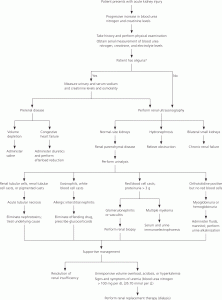
Diagnosis relies primarily on clinical context combined with laboratory evaluation.
Core Diagnostic Tests
Serum Creatinine Measurement
Serum creatinine remains the standard marker for assessing renal function despite important limitations.
Urine Output Monitoring
Oliguria is an important clinical marker but lacks sensitivity and specificity.
Urinalysis and Microscopy
Urinary sediment examination may reveal:
- Granular casts
- Red blood cell casts
- White blood cell casts
- Hematuria
- Proteinuria
These findings help distinguish glomerular, tubular, and interstitial diseases.
Imaging Studies
Renal ultrasonography is frequently performed to exclude obstructive causes of AKI.
Novel Biomarkers in AKI
Traditional biomarkers such as creatinine rise relatively late after renal injury. This limitation stimulated the development of new biomarkers capable of detecting injury earlier.

Important Emerging Biomarkers
Neutrophil Gelatinase-Associated Lipocalin (NGAL)
Neutrophil Gelatinase-Associated Lipocalin is one of the most extensively studied biomarkers for early AKI detection.
Cystatin C
Cystatin C may detect changes in glomerular filtration earlier than creatinine.
Other promising biomarkers include:
- Kidney Injury Molecule-1 (KIM-1)
- Interleukin-18
- Liver-type fatty acid-binding protein
- TIMP-2
- IGFBP7
These biomarkers may improve early diagnosis, risk stratification, and therapeutic monitoring in the future.
Drug-Induced Acute Kidney Injury
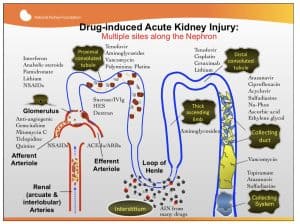
Nephrotoxic medications contribute significantly to AKI development.
Common Nephrotoxic Drugs
- Aminoglycoside antibiotics
- NSAIDs
- ACE inhibitors
- Calcineurin inhibitors
- Chemotherapeutic agents
- Radiographic contrast media
Contrast-induced nephropathy remains an important hospital-acquired cause of AKI, particularly after angiographic procedures.
Preventive measures include:
- Adequate hydration
- Minimization of contrast dose
- Use of low-osmolar or iso-osmolar contrast agents
- Avoidance of concurrent nephrotoxins
Prevention of Acute Kidney Injury
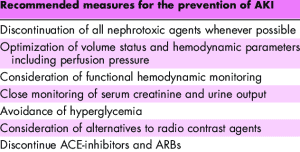
Prevention strategies focus on identifying high-risk patients and correcting precipitating factors before irreversible injury occurs.
Preventive Measures
Hemodynamic Stabilization
Maintaining adequate blood pressure and organ perfusion is essential.
Fluid Resuscitation
Appropriate intravenous fluid administration remains one of the most important interventions.
Avoidance of Nephrotoxins
Potentially harmful drugs should be discontinued or replaced whenever possible.
Early Sepsis Management
Rapid infection control reduces inflammatory renal injury.
Monitoring High-Risk Patients
Close monitoring of creatinine and urine output improves early detection.
Management of Established Acute Kidney Injury
The management of AKI primarily involves supportive care while renal recovery occurs.
Core Therapeutic Principles
- Treat underlying cause
- Maintain electrolyte balance
- Correct acid-base disorders
- Avoid further nephrotoxic exposure
- Manage fluid overload
- Provide nutritional support
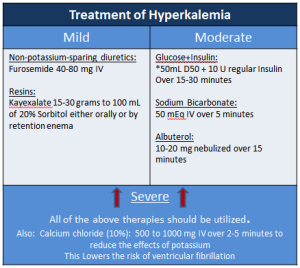
Management of Hyperkalemia
Severe hyperkalemia is a life-threatening emergency due to the risk of fatal cardiac arrhythmias.
Emergency Hyperkalemia Treatments
Potassium-Shifting Therapies
Insulin+Glucose→K+ intracellular shift\text{Insulin} + \text{Glucose} \rightarrow K^+ \text{ intracellular shift}
Additional therapies include:
- Intravenous calcium gluconate
- Sodium bicarbonate
- Nebulized beta-agonists
- Dialysis in severe cases
Renal Replacement Therapy
Severe AKI may require dialysis or continuous renal replacement therapy.
Indications for Dialysis
- Refractory hyperkalemia
- Severe metabolic acidosis
- Fluid overload
- Uremic complications
- Persistent oliguria or anuria
Types of Renal Replacement Therapy
Intermittent Hemodialysis
Provides rapid solute and fluid removal.
Continuous Renal Replacement Therapy (CRRT)
Often preferred in hemodynamically unstable critically ill patients.
Peritoneal Dialysis
Less commonly used in adults but valuable in selected settings.
Special Clinical Syndromes Associated with AKI
Hepatorenal Syndrome
Hepatorenal Syndrome is characterized by profound renal vasoconstriction occurring in severe liver failure.
Cardiorenal Syndrome
Cardiorenal Syndrome describes the bidirectional relationship between heart failure and kidney injury.
Rhabdomyolysis-Associated AKI
Rhabdomyolysis results from myoglobin-induced tubular toxicity following severe muscle injury.
Prognosis and Long-Term Outcomes
Acute kidney injury remains associated with high mortality, especially among critically ill patients.
Importantly, recovery of kidney function does not necessarily eliminate long-term risk. Numerous studies demonstrate that AKI survivors have increased susceptibility to:
- Chronic kidney disease
- End-stage renal disease
- Cardiovascular disease
- Recurrent hospitalizations
- Long-term mortality
Even brief episodes of AKI may produce lasting structural and functional renal consequences.
Conclusion
Acute kidney injury is a complex and multifactorial syndrome representing a major challenge in modern medicine. Contemporary understanding recognizes AKI as a dynamic continuum of functional and structural renal damage involving hemodynamic instability, inflammation, microvascular dysfunction, neurohormonal activation, and cellular injury pathways.
Early diagnosis, rapid identification of precipitating factors, optimization of hemodynamic status, prevention of nephrotoxic exposure, and timely supportive management remain the cornerstones of care. Emerging biomarkers and advanced extracorporeal therapies may significantly improve future diagnosis and treatment strategies.
Despite advances in critical care and nephrology, AKI continues to carry substantial short-term and long-term morbidity and mortality, highlighting the urgent need for improved preventive strategies, earlier diagnostic tools, and targeted therapeutic interventions.