
Introduction to DNA Replication Fidelity
DNA replication fidelity refers to the remarkable ability of living cells to accurately copy genetic information during cell division. This process is one of the most essential biological mechanisms because it ensures the stable transmission of genetic material from one generation of cells to the next. Even though billions of nucleotides are replicated during every cell cycle, the frequency of errors remains extremely low due to highly sophisticated molecular control systems. The preservation of genome integrity is therefore dependent on the precision of DNA polymerases, proofreading activities, DNA repair pathways, and multiple accessory proteins that collectively maintain replication accuracy.
Scientific interest in DNA replication fidelity has expanded for more than five decades because replication errors have profound biological consequences. Mutations generated by inaccurate DNA synthesis can be beneficial in certain contexts, such as evolutionary adaptation, immune system diversification, and microbial survival under environmental stress. However, these same mutations can also be harmful and contribute to genomic instability, hereditary disorders, neurodegenerative diseases, viral evolution, and cancer development. Replication-associated mutations provide the genetic variability upon which natural selection acts, but excessive mutation rates threaten cellular viability and organismal health.
The fidelity of DNA replication is not determined by a single mechanism. Instead, it results from several coordinated molecular processes that operate before, during, and after DNA synthesis. DNA polymerases selectively insert correct nucleotides, exonucleolytic proofreading removes incorrectly incorporated bases, and post-replication repair systems such as mismatch repair and excision repair further eliminate remaining errors. Together, these pathways reduce mutation frequencies to extremely low levels and maintain long-term genomic stability.

Base Substitution Fidelity and Nucleotide Selectivity
Prevention of Incorrect Nucleotide Incorporation
One of the most extensively studied aspects of DNA replication fidelity is the prevention of base substitution mutations. A base substitution occurs when an incorrect nucleotide is incorporated into the growing DNA strand and subsequently escapes proofreading and repair. DNA polymerases are therefore required to distinguish with extraordinary precision between correct and incorrect nucleotides during DNA synthesis.
Different DNA polymerases exhibit varying intrinsic error rates, typically ranging from approximately 10⁻³ to lower than 10⁻⁶ errors per incorporated nucleotide in proofreading-deficient systems. These differences depend on the polymerase type, the nature of the mismatch, and the surrounding DNA sequence environment. The inherent nucleotide selectivity of polymerases contributes more strongly to replication fidelity than many downstream repair systems, highlighting the importance of accurate nucleotide recognition during the initial stages of synthesis.
Early models explaining nucleotide selectivity were based on the classical Watson-Crick base pairing rules, which proposed that hydrogen bonding between adenine-thymine and guanine-cytosine base pairs ensured accurate DNA replication.
A−T ; G−C
However, subsequent biochemical and thermodynamic studies demonstrated that hydrogen bonding alone could not fully explain the extremely high fidelity observed in biological systems. The free-energy differences between correct and incorrect base pairs in solution are relatively small, suggesting that DNA polymerases themselves play an active role in enhancing nucleotide discrimination.
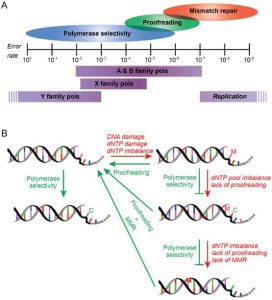
Geometric Selection and the Induced-Fit Mechanism
Structural Basis of Replication Accuracy
Modern models of DNA replication fidelity emphasize the importance of base-pair geometry and induced conformational changes within DNA polymerases. According to the geometric selection hypothesis, the active site of a DNA polymerase is structurally optimized to accommodate Watson-Crick base pairs with highly specific spatial dimensions. Correct base pairs fit precisely into the catalytic pocket, whereas mismatched nucleotides produce steric distortions that reduce incorporation efficiency.
Structural analyses of DNA polymerases revealed that the enzyme undergoes dramatic conformational rearrangements upon binding the correct nucleotide. Polymerase domains commonly referred to as the fingers, palm, and thumb subdomains coordinate DNA synthesis through dynamic structural movements. In the absence of an incoming nucleotide, polymerases typically exist in an open conformation. Binding of the correct deoxynucleoside triphosphate induces closure of the fingers domain, generating a catalytically competent active site.
These conformational transitions are essential for replication fidelity because they create additional checkpoints during nucleotide incorporation. DNA polymerases discriminate against incorrect nucleotides through three major mechanisms:
- Preferential binding affinity for correct nucleotides
- Slower conformational transitions with mismatched nucleotides
- Reduced rates of phosphodiester bond formation for incorrect incorporations
The induced-fit model therefore explains how DNA polymerases achieve extremely high selectivity beyond simple hydrogen bonding interactions.
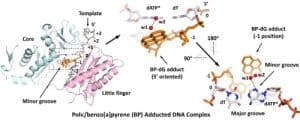
DNA Polymerase Structural Dynamics
Conformational Changes During DNA Synthesis
Crystallographic studies of DNA polymerases have significantly advanced the understanding of replication fidelity. Structural analyses of enzymes such as polymerase β, bacteriophage T7 polymerase, and HIV-1 reverse transcriptase revealed that correct nucleotide binding induces extensive rearrangements in both the polymerase and the template DNA.
These structural modifications include bending of the template strand, repositioning of catalytic amino acids, and enclosure of the incoming nucleotide within a tightly organized active-site pocket. Correct nucleotide incorporation aligns catalytic magnesium ions and reactive phosphate groups in an orientation favorable for phosphodiester bond formation.
DNAn+dNTP→DNAn+1+PPi
Incorrect nucleotides fail to induce these optimal structural transitions efficiently. As a result, catalysis becomes substantially slower, and the probability of mismatch removal increases.
Specific amino acid residues located within polymerase active sites play crucial roles in maintaining replication fidelity. Mutations affecting these residues can dramatically alter nucleotide selectivity and produce mutator or antimutator phenotypes. Some substitutions reduce steric exclusion and increase misincorporation rates, while others strengthen discrimination against mismatches.

Mutator and Antimutator DNA Polymerases
Polymerase Mutations and Error Specificity
Studies of mutant DNA polymerases have demonstrated that even single amino acid substitutions can significantly influence replication fidelity. Mutator polymerases exhibit elevated error rates, whereas antimutator polymerases possess enhanced nucleotide discrimination capabilities.
Certain mutations alter interactions with the template strand, incoming nucleotide, or primer terminus, thereby modifying active-site geometry and catalytic efficiency. For example, replacement of key amino acids involved in minor groove recognition often increases misincorporation frequencies because the polymerase becomes less capable of distinguishing correct from incorrect base-pair structures.
Interestingly, some mutant polymerases display highly specific error signatures rather than generalized mutagenesis. A polymerase may exhibit increased fidelity overall while remaining highly error-prone for particular nucleotide sequences or mismatch types. This observation demonstrates that replication fidelity depends not only on polymerase structure but also on local sequence context and DNA geometry.

Hydrogen Bonding, Base Analogues, and Replication Fidelity
Role of Nonpolar Base Analogues
To investigate the relative contributions of hydrogen bonding and geometric complementarity, researchers developed synthetic nonpolar base analogues that mimic the shape of natural nucleotides while lacking traditional hydrogen-bonding potential.
Experiments using these analogues revealed that DNA polymerases can still replicate DNA with surprisingly high efficiency even in the absence of standard hydrogen bonds. These findings strongly support the concept that steric complementarity and active-site geometry are dominant determinants of nucleotide selectivity.
The use of modified nucleotides also demonstrated that DNA polymerases can occasionally accommodate unusual base conformations generated through tautomerization, ionization, or syn-anti rotational changes. Such rare alternative structures may contribute to spontaneous mutagenesis by transiently allowing incorrect base pairing geometries that resemble normal Watson-Crick interactions.
Oxidative DNA lesions such as 8-oxo-deoxyguanosine represent important examples of mutagenic base analogues capable of inducing transversion mutations.
Mismatch Extension and Duplex DNA Recognition
Extension of Incorrectly Paired Termini
A replication error becomes permanent only if a mismatched primer terminus is successfully extended. Consequently, the ability of DNA polymerases to discriminate against mismatch extension is another essential determinant of replication fidelity.
Structural studies revealed that DNA polymerases interact extensively with duplex DNA upstream of the active site. These interactions involve electrostatic contacts with the phosphate backbone as well as hydrogen bonds within the minor groove of the DNA helix. Such contacts enable polymerases to sense distortions caused by mismatches even several nucleotides away from the catalytic center.
Mismatch-containing primer termini are extended much less efficiently than correctly paired termini because structural distortions interfere with conformational transitions and catalytic alignment. Some polymerases, however, exhibit greater tolerance for mismatches and therefore possess lower replication fidelity.
The sensitivity of mismatch extension varies among polymerases depending on their structural organization and DNA-binding properties. Polymerases with extensive minor groove interactions generally display stronger discrimination against mismatches than enzymes with fewer duplex DNA contacts.
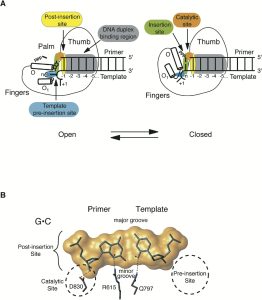
Exonucleolytic Proofreading
Error Correction by 3′→5′ Exonuclease Activity
Many replicative DNA polymerases possess intrinsic proofreading activity mediated by a 3′→5′ exonuclease domain. This proofreading system provides an additional layer of replication fidelity by excising incorrectly incorporated nucleotides before synthesis continues.
3′→5′ exonuclease
Proofreading efficiency depends on the kinetic balance between mismatch extension and exonucleolytic excision. Correctly paired termini are rapidly extended, whereas mismatches slow polymerization and increase the probability that the primer terminus will transfer from the polymerase active site to the exonuclease site.
Structural analyses revealed that polymerase and exonuclease domains are physically separated by approximately 30–40 Å within many DNA polymerases. Mismatched termini are more likely to fray and become single-stranded, allowing them to enter the exonuclease domain for removal.
Proofreading can enhance replication fidelity by several hundred-fold depending on the mismatch type, local sequence context, and polymerase structure. However, proofreading efficiency decreases within repetitive DNA regions where misaligned intermediates become more stable and more difficult to detect.

Strand Misalignment and Frameshift Mutations
Replication Errors in Repetitive Sequences
In addition to base substitutions, DNA replication generates insertion and deletion mutations resulting from strand misalignment mechanisms. These frameshift mutations occur particularly frequently within repetitive DNA sequences such as microsatellites and trinucleotide repeats.
The template-primer slippage model explains how these errors arise during replication of repeated nucleotide sequences. Temporary dissociation and misalignment of template and primer strands generate looped intermediates stabilized by complementary base pairing. Continued synthesis after slippage produces either insertions or deletions depending on whether the extra nucleotide resides in the primer or template strand.
Frameshift mutation rates increase dramatically as repetitive sequence length increases because longer repeats stabilize misaligned intermediates more effectively. This phenomenon contributes directly to microsatellite instability observed in many cancers and to trinucleotide repeat expansions associated with hereditary neurological disorders.

Sequence Context and Polymerase-Specific Error Profiles
Influence of DNA Sequence Environment
Replication fidelity is strongly influenced by local DNA sequence context. Certain sequences function as mutation hotspots because they favor mispairing, slippage, or abnormal DNA conformations.
Homopolymeric runs are particularly susceptible to insertion and deletion mutations. Polymerases often generate higher deletion rates in pyrimidine-rich sequences than in purine-rich regions, possibly due to weaker base-stacking interactions between pyrimidines.
Different DNA polymerases also exhibit distinct error signatures depending on their structural properties and interactions with DNA. For example, HIV-1 reverse transcriptase displays unusually high frameshift frequencies within specific repetitive regions, contributing to rapid viral evolution and drug resistance development.
Proofreading of Strand Misalignment Errors
Correction of Insertion and Deletion Intermediates
Proofreading mechanisms can remove certain strand misalignment intermediates before mutation fixation occurs. Misaligned structures near the primer terminus may transfer to the exonuclease active site and undergo excision.
However, proofreading efficiency declines significantly within long repetitive sequences because extra nucleotides may be located far from the primer terminus and therefore fail to strongly impede polymerization. As repetitive tract length increases, strand slippage becomes more frequent while proofreading becomes less effective.
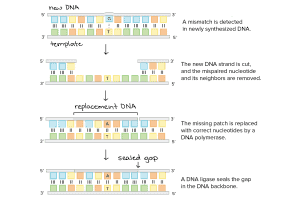
This reduced proofreading efficiency explains why mismatch repair systems become critically important for maintaining microsatellite stability. Defects in mismatch repair genes produce strong microsatellite instability phenotypes frequently observed in colorectal and other cancers.
Contribution of Accessory Proteins to Replication Fidelity
Processivity Factors and Fidelity Modulation
DNA replication in vivo involves large multiprotein complexes rather than isolated polymerases. Accessory proteins such as sliding clamps, clamp loaders, single-stranded DNA-binding proteins, and processivity factors modulate replication efficiency and fidelity.
Some accessory proteins enhance fidelity by stabilizing polymerase-DNA interactions and reducing opportunities for strand slippage. Others paradoxically increase mutagenesis by promoting extension of mismatches or damaged templates.
For example, proliferating cell nuclear antigen (PCNA) enhances polymerase processivity but can also facilitate lesion bypass during translesion synthesis. Mutations affecting accessory proteins frequently produce elevated mutation rates, demonstrating their essential role in maintaining genome stability.
Fidelity of Multiprotein Replication Complexes
Coordination of Leading and Lagging Strand Synthesis
Replication fidelity differs between leading and lagging strand synthesis because these processes are mechanistically distinct. Leading-strand synthesis occurs continuously, whereas lagging-strand synthesis requires repeated initiation of Okazaki fragments.
Lagging-strand replication involves multiple polymerase switching events, RNA primer removal, flap processing, and gap filling. These additional steps create unique opportunities for both error generation and error correction.
Specialized enzymes such as flap endonucleases help remove errors introduced during Okazaki fragment initiation. Defects in these pathways contribute to repeat expansion disorders and genomic instability syndromes.
Fidelity of DNA Repair Synthesis
Accuracy During Genome Repair
DNA repair pathways also require highly accurate DNA synthesis. Base excision repair, nucleotide excision repair, and mismatch repair all involve gap-filling DNA polymerization steps that must maintain genome integrity.
The enormous quantity of spontaneous DNA damage occurring daily in human cells means that repair-associated synthesis represents a substantial source of potential mutagenesis. Accurate coordination between repair polymerases, proofreading enzymes, and mismatch repair systems is therefore essential for preventing accumulation of repair-induced mutations.
Specialized DNA Polymerases and Translesion Synthesis
DNA Damage Bypass Mechanisms
Recent discoveries identified numerous specialized DNA polymerases capable of translesion synthesis across damaged DNA templates. These polymerases belong to distinct families characterized by low fidelity, distributive synthesis, and flexible active sites capable of accommodating DNA lesions.
Translesion polymerases allow replication to continue despite DNA damage that would otherwise stall high-fidelity replicative polymerases. However, this flexibility comes at the cost of increased mutagenesis.
Examples include DNA polymerases IV and V in bacteria, as well as polymerases η and ζ in eukaryotes. Human polymerase η plays a particularly important role in bypassing ultraviolet-induced thymine dimers. Defects in this enzyme cause the xeroderma pigmentosum variant syndrome, which is associated with elevated skin cancer susceptibility.

Biological Importance of DNA Replication Fidelity
Genome Stability, Evolution, and Disease
DNA replication fidelity is fundamental to nearly every aspect of molecular biology, genetics, and cellular physiology. Accurate replication preserves species identity and genome stability, whereas controlled mutagenesis enables adaptation and evolution.
Replication errors contribute to cancer initiation, hereditary disease development, viral evolution, antibiotic resistance, aging, and neurodegeneration. Conversely, beneficial mutations generated during replication drive evolutionary innovation and immune diversification.
The balance between stability and mutability therefore represents a central principle of biological systems.
Conclusion
DNA replication fidelity results from the coordinated action of nucleotide selectivity, induced-fit catalysis, proofreading exonuclease activity, mismatch repair, accessory proteins, and specialized DNA repair pathways. Structural and biochemical studies have revealed extraordinary molecular precision within DNA polymerases and replication complexes, demonstrating how living cells achieve accurate genome duplication despite enormous biochemical complexity.
Although major principles governing replication fidelity are now well established, many questions remain unresolved. Future research continues to focus on high-resolution polymerase structures, dynamics of conformational transitions, mechanisms of lesion bypass, interactions between replication and repair pathways, and the biological consequences of mutational processes in health and disease.
The continuing discovery of novel DNA polymerases and replication-associated proteins demonstrates that the molecular mechanisms controlling genome stability are even more diverse and sophisticated than previously imagined.